
When starting out as an entrepreneur or SME, you can be forgiven for arguing with yourself over one major question: to business plan, or not to business plan?
Studies, research papers and blogs all have their own opinions on the matter. For some, business planning is the first thing you should throw yourself into when starting as an entrepreneur/enterprise. Others tell the story of how they entered into the market with nothing more than a good idea and are now a fully fledged industry behemoth (strange how you never hear of the ones who didn’t plan and failed…).
The message coming out of some mainstream entrepreneurship over the past decade has been one in support of planning. This is usually accompanied by the expectation that an enterprise, founded with a business plan, will perform better in the market than one without. In the end for every piece of research supporting business plans, there is an opposing piece against them and it seems its split evenly down the middle. For the fledgling entrepreneur this isn’t much help.
However, there’s a larger problem when it comes to business planning, and that’s measuring the effectiveness of the plan itself. It would be near-impossible to compare an identical business idea: one including a business plan, and one omitting it.
The majority of studies investigating business plans tend to look at after-the-event effects and compare the relationship between performance and planning. However, instead of looking at the success/failure of start-ups that have either planned or not planned, Chwolka and Raith (2011) adopt a different approach. The authors instead analyse the entrepreneur’s decision to plan from his/her point of view. In their own words “planning is an activity that the entrepreneur will only choose to perform, if the benefits of planning outweigh the costs”.
The authors take the assumption that business planning before a start-up will not have any influence on the profitability of a venture. Their approach allows them to specify where business planning occurs in the entrepreneurial process. This enables them to work out the value of planning at that specific point in the process based on the entrepreneur’s expectations. The method as a whole lets us “see what the entrepreneur chooses to do, but also understand why he does it”.
The diagram below shows the decision path for the entrepreneur. The upper branches show a business plan being implemented before a start-up. The purpose of planning is to analyse the potential success of a start-up, so the entrepreneur should expect some feedback on the ventures potential for success. This will either be positive or negative and will then inform a decision on whether to enter the market with the start-up. From here, the venture will either be a success or a failure in its market. Through the decision path there are decisions, chances, and payoffs.
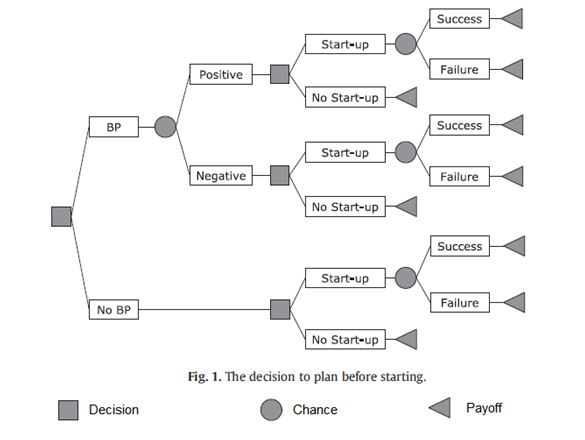
Planning has an important use, especially in opportunity assessment for an entrepreneur faced with the decision to enter into the market. According to Chwolka and Raith, planning has its impact before market entry, as it can help to avoid a poor start-up. The value of the planning is determined by quality of the actual plan and the nature of the venture. It is measured by the entrepreneur’s expected performance of the venture (ex-ante).
Most studies only view the actual results of planned ventures that have entered the market (ex-post), but this only looks at half of the picture when it comes to business planning. The authors use their framework to draw “observable consequences from a hypothetical world” and it allows them to provide answers to several open questions concerning the behaviour of entrepreneurs.
Take aways
Business plans can be measured at the point where the entrepreneur decides whether or not to plan. This contrasts with most studies that compare firms’ performance after market entry.
Planning before market entry and help an entrepreneur evaluate and determine alternate actions, improving strategies and showing the value of the business plan.
The value of planning is determined by the venture under consideration and is heavily attributed to the quality of the actual plan.
Based on: Chwolka, A., Raith, M. G. (2011). The value of business planning before start-up – A decision-theoretical perspective.
Blog by Anthony…